

Kling 4.0 vs Seedance 2.5: What's New and Which to Use
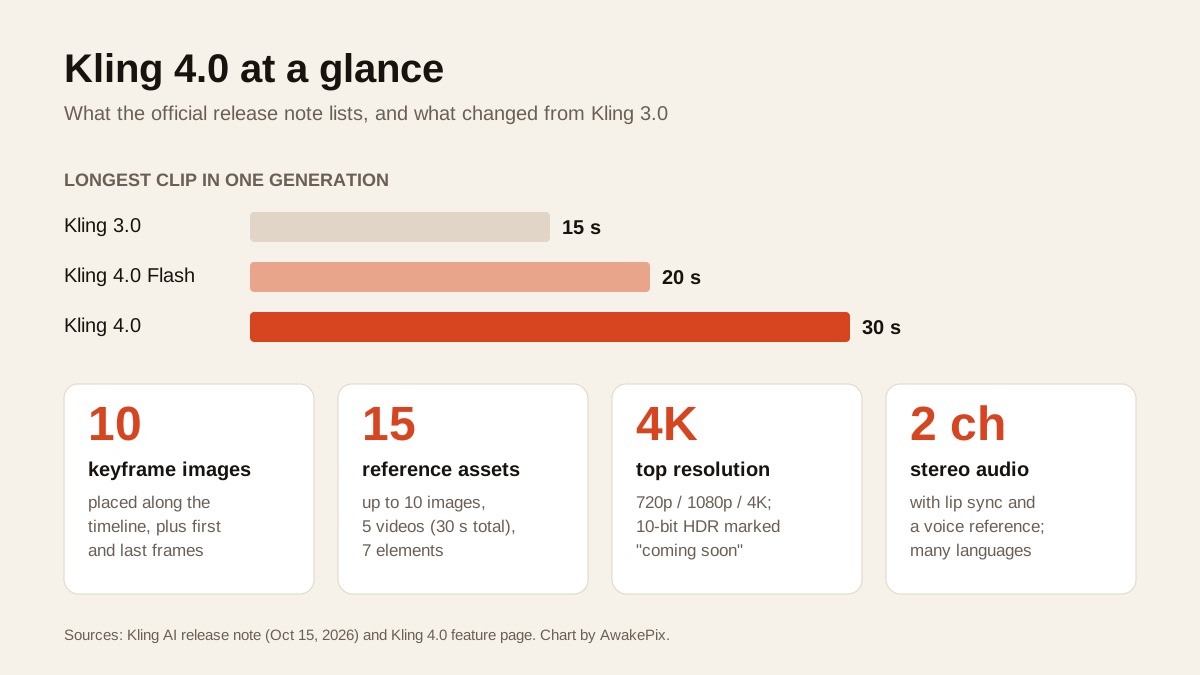
Short answer: Kling 4.0 became available to everyone on October 15, 2026. The headline upgrades are 30-second clips in one generation (up from 15 seconds), up to 10 keyframe images, up to 15 reference assets in a single prompt, and stereo audio with lip sync. A lighter Kling 4.0 Flash handles fast 720p drafts up to 20 seconds. Against Seedance 2.5, Kling 4.0 now leads on clip length and timeline control, while early third-party tests still favour Seedance 2.5 when a product or face has to stay exactly the same.
Below: the confirmed specs, the Flash vs full-model split, a side-by-side with Seedance 2.5, and our own same-input test of the models you can use on AwakePix today.
Kling 4.0 specs: what the release note confirms
Everything in this table comes from Kling's own release note, "Meet All-New Kling 4.0!". Two items are labelled "coming soon" there, so we mark them that way.
| Capability | Kling 4.0 |
|---|---|
| Inputs | Text, image, first and last frames, Omni Reference |
| Keyframes | Up to 10 keyframe images on the timeline |
| Clip length | 3 to 30 seconds per generation |
| Resolution | 720p, 1080p, 4K |
| HDR | 10-bit HDR at 1080p and 4K (coming soon) |
| Aspect ratios | 21:9, 16:9, 1:1, 9:16, Auto |
| Audio | Two-channel stereo, lip sync, voice reference |
| References | Up to 15 items: 10 images, 5 videos (30 s combined), 7 elements |
| Prompt length | Up to 8,000 tokens |
| Editing | Up to 5 input clips, 30 seconds combined |
| Extension | Up to 2 minutes across several extensions (coming soon) |
Two details are easy to miss. Kling now accepts depth-map and "white-model" videos as motion references, which means you can copy the movement and camera path of a clip without copying how it looks. It also claims clear on-screen text in nine languages plus emoji, which earlier video models were notoriously bad at.
Kling 4.0 vs Kling 4.0 Flash
Flash is not a cut-down preview. It is a separate, faster tier meant for frequent drafts. The trade-off is resolution and control.
| Kling 4.0 Flash | Kling 4.0 | |
|---|---|---|
| Clip length | 3 to 20 seconds | 3 to 30 seconds |
| Resolution | 720p | 720p, 1080p, 4K |
| Dynamic range | 8-bit SDR | 10-bit HDR (coming soon) |
| First and last frames | Not listed | Yes |
| Multi-keyframes | Not listed | Up to 10 |
| Omni Reference | Yes | Yes |
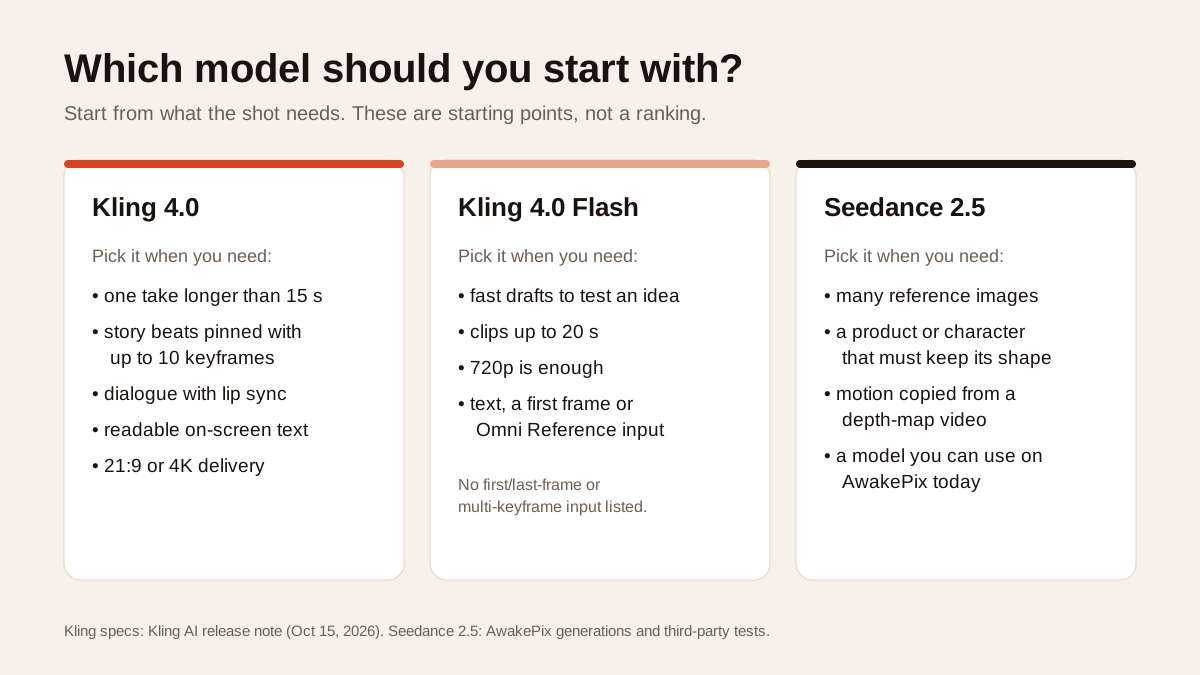
Rule of thumb: use Flash to find the idea, then re-run the keeper on the full model when you need 1080p or above, a pinned ending frame, or more than 20 seconds.
What changed from Kling 3.0
- Twice the length. Kling 3.0 topped out at 15 seconds per generation; 4.0 goes to 30, so a full beat-by-beat story can live in one take instead of three stitched clips.
- Keyframes instead of just a start frame. You can now pin up to 10 moments along the timeline: where a character stands, when a door opens, how the shot ends.
- Mixed references. Images, short videos, a voice and reusable "elements" can all go into the same generation, up to 15 items in total.
- Sound that matches the mouth. Stereo output and lip sync, with accents and dialects listed for Chinese and English.
- Recreation and editing. Kling now pitches swapping the product or character in an existing ad while keeping its pacing, and making targeted edits without regenerating the whole shot.
Kling 4.0 vs Seedance 2.5
Seedance 2.5 is the model Kling 4.0 is most often compared with, because both target reference-driven, multi-shot production. Here is how the published limits line up. For Seedance 2.5 we list the limits in the API documentation we integrate against.
| Kling 4.0 | Seedance 2.5 | |
|---|---|---|
| Longest single clip | 30 s | 30 s |
| Reference images | Up to 10 | Up to 30 |
| Reference videos | Up to 5, 30 s combined | Up to 10, 30 s combined |
| Depth-map motion reference | Yes | Yes (we use it in production) |
| Keyframes on a timeline | Up to 10 images | Via prompt, no dedicated keyframe input |
| Top resolution | 4K | 1080p |
| Audio | Stereo, lip sync | Generated audio |
| Edit and extend an existing clip | Edit now, extend coming soon | Separate edit and extend endpoints |
On paper, Kling 4.0 wins on resolution and explicit keyframe control, while Seedance 2.5 takes more reference material per request.
What about real output? There is no neutral benchmark that includes Kling 4.0 yet. The most detailed test we found is a single-run comparison of Kling 4.0 Flash against Seedance 2.5 published by Atlas Cloud on October 10. Atlas Cloud resells both models, so treat it as one data point. In their product test, Seedance 2.5 kept a running shoe's shape across cuts while Flash flattened the tread. In a two-person dialogue scene, both lip-synced well, but Flash lost fine texture in wide shots. Neither model managed a clean continuous sit-to-stand move between two keyframes. That test covers Flash only, not the full Kling 4.0 model.
Our test: one start frame, four models
We cannot test Kling 4.0 on AwakePix yet, but we can show what the models already on AwakePix do with the same image. Every clip below started from this one frame:

Seedance 2.5, Seedance 2.0 and Wan 3.0 got the identical prompt: "A slow, small-amplitude push-in. Keep the subject and composition unchanged." MiniMax H3 got a longer prompt describing the same push-in, the steam and the passing fields. Each model ran once at its standard setting on AwakePix. Here is the frame at 4.6 seconds from each clip:
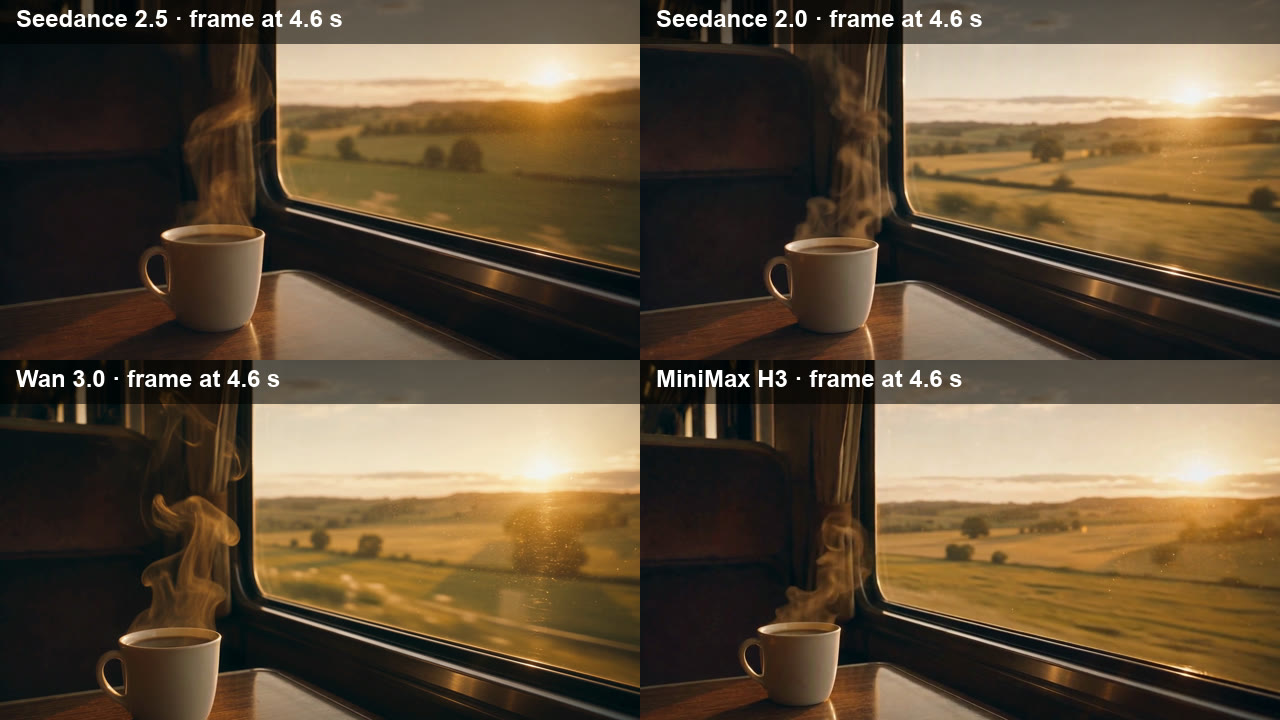
What we saw:
- All four kept the cup, table and window where they belong. For a simple push-in, every current model is reliable.
- The steam is where they differ. Wan 3.0 drew the thickest, most stylised curls, Seedance 2.0 a tall dense column, Seedance 2.5 thin wisps, and MiniMax H3 the faintest.
- They read "slow push-in" differently. Compared with the start frame, Seedance 2.5 moved in the most, so the cup looks largest, while MiniMax H3 moved the least.
- Waits ranged from about 2 to 5 minutes. In our measured runs Wan 3.0 finished in 122 seconds, MiniMax H3 in 201, Seedance 2.0 in 245 and Seedance 2.5 in 297. Queues change, so treat these as single observations.
When Kling 4.0 is available to us, we will run it on the same frame and add it here.
Can you use Kling 4.0 on AwakePix?
Not yet. We are preparing the integration and will only open it after a real generation passes our checks. The Kling 4.0 Flash page lets you draft prompts in the meantime. If you want to start now, try Seedance 2.5 or compare the video models already available. You can also turn a photo into a short clip with the image-to-video generator.
AwakePix is an independent platform and is not affiliated with or sponsored by Kling AI.
FAQ
When was Kling 4.0 released? Kling's release note says Kling 4.0 became available to everyone on October 15, 2026. Kling 4.0 Flash opened earlier to a limited group of users.
How long can a Kling 4.0 video be? 3 to 30 seconds per generation for Kling 4.0, and 3 to 20 seconds for Flash. Kling lists video extension up to 2 minutes in total as coming soon.
What is the difference between Kling 4.0 and Kling 4.0 Flash? Flash is faster and limited to 720p, 8-bit SDR and 20 seconds. The full model goes to 4K, 30 seconds, and adds first and last frames plus up to 10 keyframes.
Does Kling 4.0 support 4K and HDR? 4K output is listed. 10-bit HDR at 1080p and 4K is marked as coming soon.
Is Kling 4.0 better than Seedance 2.5? It depends on the shot. Kling 4.0 offers longer clips, 4K and explicit keyframes. Seedance 2.5 accepts more reference images, and early tests found it holds product and facial detail more steadily. Test both on your own material before you commit.
Does Kling 4.0 have an API? Kling says Kling 4.0 is available through its MCP server and CLI. Check Kling's API platform for current API access.
Sources: Kling AI release note, "Meet All-New Kling 4.0!"; Kling 4.0 feature page (Kling 3.0's 15-second limit); EvoLink Seedance 2.5 reference-to-video documentation; Atlas Cloud, Kling 4.0 Flash vs Seedance 2.5 test (October 10, 2026). Same-input clips and timings: AwakePix's own generations. Specs checked October 18, 2026.